AI in Philanthropy and Modern Fundraising
 Chinafoundations Team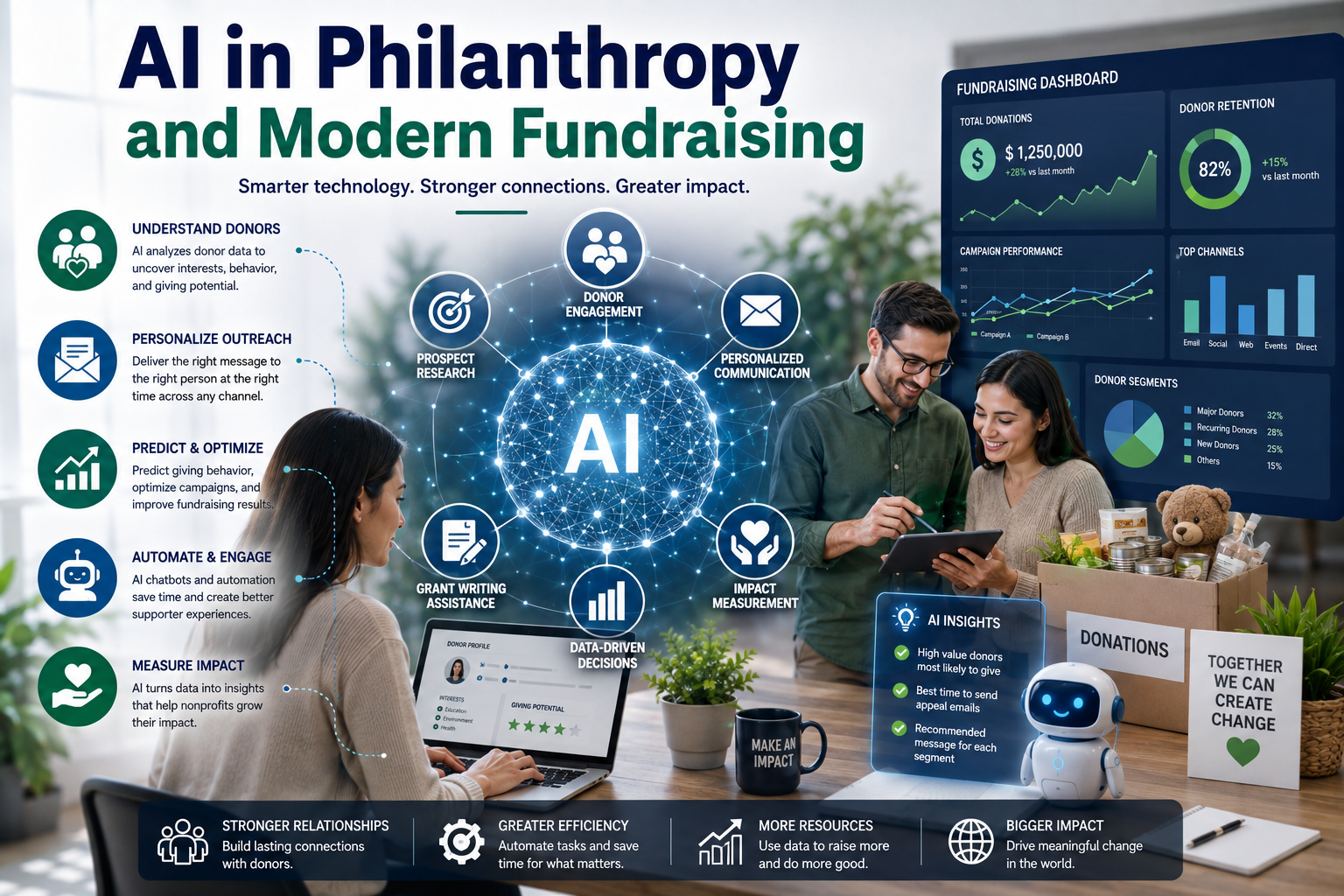
AI in Philanthropy and Modern Fundraising - Artificial intelligence (AI) is rapidly transforming how organizations operate, communicate, and make decisions. While AI has become a major force in industries such as healthcare, finance, and retail, it is also creating significant opportunities within the nonprofit sector. From donor engagement and fundraising campaigns to grant management and impact measurement, AI is helping charitable organizations work smarter and achieve greater results.
As competition for donor attention grows and nonprofit resources remain limited, many organizations are turning to AI-powered tools to improve efficiency and maximize their impact. These technologies are helping charities better understand donors, personalize communications, automate repetitive tasks, and make data-driven decisions.
This article explores the growing role of AI in philanthropy and modern fundraising, including its benefits, practical applications, challenges, and future potential.
Understanding AI in Philanthropy
AI in philanthropy refers to the use of artificial intelligence technologies to support charitable giving, nonprofit management, fundraising, donor relations, and social impact initiatives.
AI systems can process large amounts of information, identify patterns, and generate insights that would be difficult or time-consuming for humans to uncover manually.
Common AI technologies used in philanthropy include:
- Machine learning
- Predictive analytics
- Natural language processing
- Generative AI
- Chatbots and virtual assistants
- Data analytics platforms
These tools allow nonprofits to streamline operations and focus more resources on mission-driven activities.
Why Nonprofits Are Adopting AI
The nonprofit sector faces growing pressure to do more with limited budgets and staff.
Organizations must:
- Attract and retain donors
- Demonstrate measurable impact
- Manage increasing amounts of data
- Deliver effective programs
- Communicate with supporters across multiple channels
AI helps address these challenges by improving efficiency and enabling more informed decision-making.
As AI tools become more affordable and accessible, nonprofits of all sizes are beginning to integrate them into their daily operations.
AI and Donor Engagement
One of the most valuable applications of AI in philanthropy is donor engagement.
Building strong donor relationships is essential for long-term fundraising success. However, maintaining personalized communication with thousands of supporters can be difficult.
AI helps nonprofits understand donor behavior by analyzing:
- Giving history
- Donation frequency
- Event participation
- Website activity
- Email engagement
- Volunteer involvement
Using this information, organizations can create highly personalized outreach strategies.
For example, AI may identify donors interested in environmental programs and automatically tailor communications around conservation initiatives rather than sending generic fundraising messages.
This personalized approach often leads to stronger relationships and increased donor loyalty.
Improving Fundraising Campaigns
Fundraising campaigns generate large amounts of data that can be difficult to analyze manually.
AI-powered analytics help organizations identify patterns and opportunities that improve campaign performance.
These tools can:
- Predict donor response rates
- Identify high-potential prospects
- Recommend optimal donation requests
- Determine the best communication channels
- Suggest ideal campaign timing
By leveraging predictive insights, nonprofits can allocate resources more effectively and improve fundraising outcomes.
Rather than relying solely on intuition, organizations can use data-driven strategies to maximize campaign success.
Predictive Analytics for Donor Retention
Donor retention remains one of the biggest challenges in fundraising.
Many organizations focus heavily on acquiring new donors while struggling to keep existing supporters engaged.
AI-powered predictive analytics can identify donors who may be at risk of disengaging.
The system analyzes various indicators, including:
- Changes in giving patterns
- Reduced communication engagement
- Event participation trends
- Website interactions
This allows fundraising teams to proactively reconnect with supporters before they stop contributing.
Retaining donors is often more cost-effective than acquiring new ones, making predictive analytics an especially valuable tool.
AI-Powered Prospect Research
Finding new donors traditionally requires extensive research and manual effort.
Fundraising professionals often spend significant time gathering information about potential supporters.
AI simplifies this process by analyzing public data and identifying individuals who may have both the capacity and interest to support a cause.
AI tools can help organizations:
- Discover potential major donors
- Analyze philanthropic interests
- Identify professional connections
- Track giving patterns
- Prioritize outreach efforts
This enables development teams to focus on building relationships rather than spending countless hours on research.
Chatbots and Virtual Assistants
Many nonprofits are using AI-powered chatbots to improve communication with supporters.
Chatbots can:
- Answer common questions
- Provide donation information
- Assist event registrations
- Guide volunteers
- Offer program updates
Because chatbots operate around the clock, they provide immediate support even when staff members are unavailable.
This improves user experience while reducing administrative workload.
As AI technology continues to improve, virtual assistants are becoming increasingly sophisticated and capable of handling more complex interactions.
AI and Grant Writing
Grant writing is often one of the most time-consuming responsibilities within nonprofit organizations.
Many charities have limited staff dedicated to researching funding opportunities and preparing proposals.
Generative AI tools can assist by:
- Drafting proposal sections
- Summarizing organizational information
- Creating project descriptions
- Improving grammar and clarity
- Organizing supporting documentation
These tools help reduce administrative burdens and allow staff to focus on strategic planning and program development.
However, human oversight remains essential to ensure accuracy, authenticity, and alignment with funder requirements.
Measuring Social Impact
Demonstrating impact is increasingly important for donors, foundations, and stakeholders.
AI can help nonprofits collect, analyze, and interpret data related to program outcomes.
Applications include:
- Tracking beneficiary outcomes
- Monitoring project performance
- Evaluating program effectiveness
- Identifying trends and challenges
- Generating impact reports
With better data analysis, organizations can make more informed decisions and continuously improve their programs.
This also strengthens transparency and accountability.
Enhancing Marketing and Content Creation
Modern fundraising relies heavily on digital marketing and content creation.
AI-powered tools can assist with:
- Email campaigns
- Social media content
- Blog writing
- Donor newsletters
- Advertising copy
- Campaign messaging
By automating routine content tasks, nonprofits can maintain consistent communication while reducing workload.
AI can also analyze engagement metrics to determine which messages resonate most effectively with audiences.
This helps organizations refine their communication strategies over time.
Benefits of AI in Modern Fundraising
The growing adoption of AI offers numerous advantages for nonprofit organizations.
Increased Efficiency
Automation reduces time spent on repetitive tasks such as data entry, donor segmentation, and reporting.
This allows staff to focus on relationship-building and mission-critical activities.
Better Decision-Making
AI provides insights based on real data rather than assumptions.
Organizations can make more strategic decisions regarding fundraising, outreach, and program development.
Improved Personalization
Personalized donor experiences often lead to higher engagement and stronger long-term relationships.
AI makes personalization possible at scale.
Greater Fundraising Potential
Predictive analytics and donor insights can help organizations identify opportunities to increase donations and improve campaign performance.
Enhanced Impact Measurement
AI enables more accurate tracking and reporting of social outcomes, helping nonprofits demonstrate effectiveness to supporters and funders.
Challenges and Ethical Considerations
While AI offers significant benefits, it also presents challenges that organizations must address.
Data Privacy
Nonprofits often collect sensitive donor and beneficiary information.
Organizations must ensure AI systems comply with privacy regulations and maintain strong data protection practices.
Algorithmic Bias
AI systems can unintentionally reflect biases present in training data.
This may influence donor targeting, grant evaluations, or resource allocation decisions.
Regular monitoring and diverse datasets can help reduce these risks.
Transparency
Supporters increasingly expect organizations to be transparent about how technology is used.
Nonprofits should clearly communicate how AI contributes to decision-making processes.
Human Connection
Fundraising is fundamentally about relationships and trust.
While AI can improve efficiency, it cannot replace empathy, compassion, and authentic human interaction.
Successful organizations use AI as a complement to human engagement rather than a substitute.
Future Trends in AI and Philanthropy
Several emerging trends are expected to shape the future of AI-powered fundraising.
Hyper-Personalized Giving Experiences
AI will continue improving the ability to customize donor communications based on individual preferences and behaviors.
Smarter Fundraising Predictions
Future AI systems will become increasingly accurate in forecasting donor behavior and campaign outcomes.
Voice and Conversational AI
Voice assistants and conversational AI tools may become more common in donor engagement and support services.
Advanced Impact Analytics
Organizations will gain deeper insights into program effectiveness through more sophisticated data analysis tools.
Increased Accessibility
As AI solutions become more affordable, smaller nonprofits will gain access to technologies previously available only to large organizations.
Best Practices for Nonprofits Using AI
Organizations considering AI adoption should follow several key principles:
- Start with clear objectives.
- Focus on solving specific problems.
- Protect donor and beneficiary data.
- Maintain human oversight.
- Measure results consistently.
- Ensure transparency and accountability.
- Invest in staff training.
A thoughtful approach can help organizations maximize benefits while minimizing risks.
Conclusion
AI is transforming philanthropy and modern fundraising by helping nonprofits work more efficiently, engage donors more effectively, and measure impact more accurately. From predictive analytics and personalized donor outreach to grant writing and impact reporting, AI provides powerful tools that can enhance every stage of the fundraising process.
While challenges related to privacy, bias, and transparency must be carefully managed, the potential benefits are substantial. Organizations that embrace AI responsibly can strengthen donor relationships, improve operational efficiency, and increase their overall social impact.
As technology continues to evolve, AI is likely to become an increasingly important component of successful philanthropy and fundraising strategies. The future of charitable giving will not be defined by technology alone but by how organizations combine innovative tools with human compassion, trust, and a commitment to meaningful change.