Powerful Ways AI for Nonprofits Is Transforming Charitable Impact
 Chinafoundations Team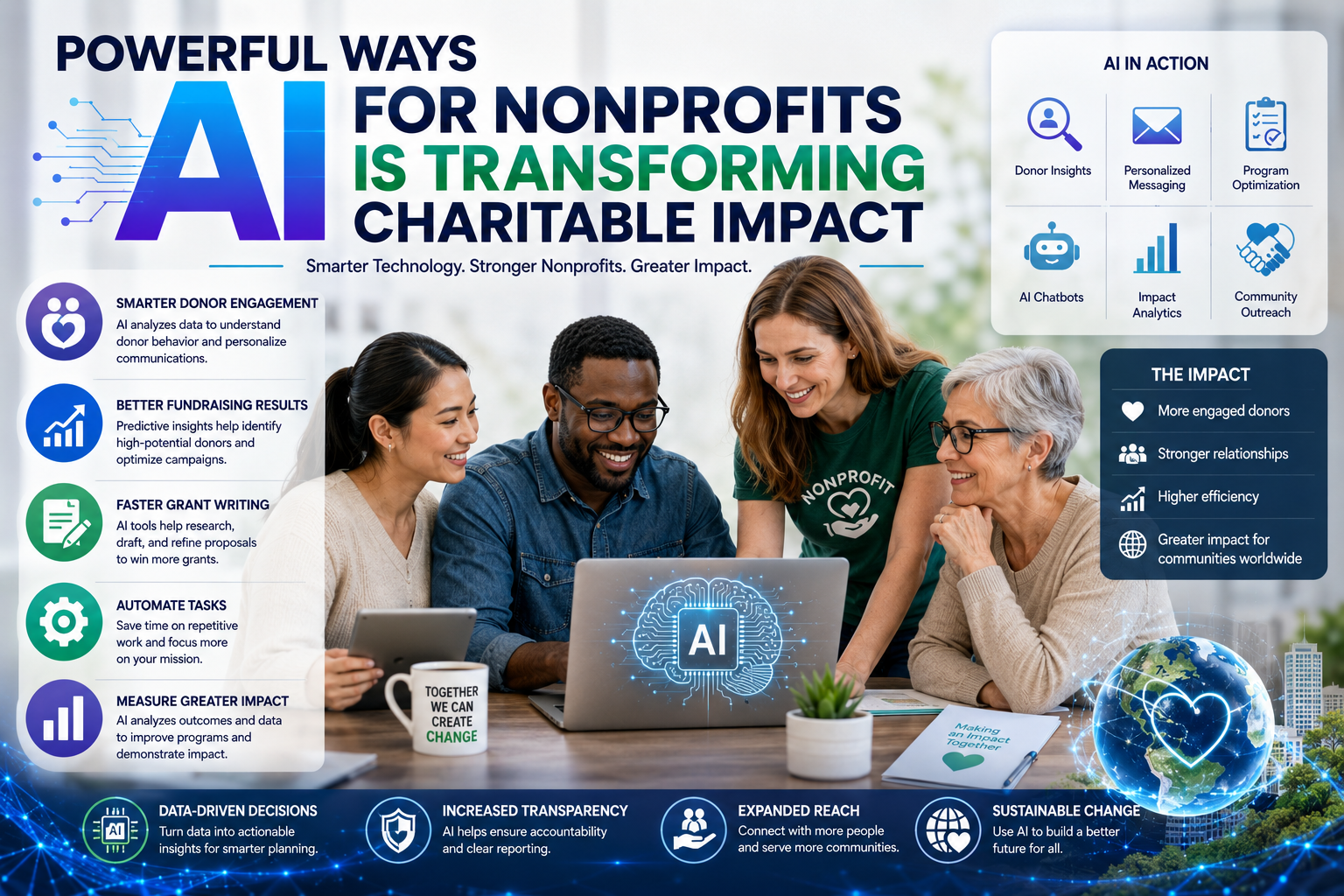
Powerful Ways AI for Nonprofits Is Transforming Charitable Impact - Artificial intelligence (AI) is no longer a technology reserved for large corporations and technology companies. In 2026, nonprofits around the world are increasingly adopting AI to improve fundraising, strengthen donor relationships, streamline operations, and expand their social impact. What was once considered an experimental tool is rapidly becoming a practical resource that helps organizations achieve more with limited budgets and staff.
The nonprofit sector faces constant challenges, including increasing demand for services, rising operational costs, and growing competition for donor attention. AI offers solutions that help organizations work more efficiently while improving their ability to fulfill their missions.
From donor engagement and grant writing to impact measurement and program delivery, AI is transforming charitable work in powerful ways. Organizations that embrace AI strategically are discovering new opportunities to serve communities, raise funds, and create meaningful change. Recent nonprofit research shows that AI adoption is now widespread across the sector, though organizations that combine technology with clear strategies are seeing the greatest benefits.
The Growing Role of AI for Nonprofit Sector
The AI for nonprofit world has traditionally relied heavily on human expertise, volunteer support, and community relationships. While these elements remain essential, AI is helping organizations enhance their capabilities.
AI technologies can process large amounts of information, identify patterns, automate repetitive tasks, and generate valuable insights. This allows nonprofit teams to focus more time on mission-driven activities rather than administrative work.
Industry studies show that AI for nonprofit adoption has accelerated significantly, with a large majority of organizations now using AI in some capacity. However, only a smaller percentage are currently achieving transformational impact, highlighting the importance of thoughtful implementation rather than simply adopting tools.
Smarter Donor Engagement
One of the most powerful uses of AI in nonprofits is improving donor engagement.
Building strong donor relationships is critical for fundraising success. AI helps organizations better understand donor interests, preferences, and behaviors through data analysis.
AI can examine:
- Donation history
- Event participation
- Email engagement
- Website activity
- Volunteer involvement
- Communication preferences
Using these insights, nonprofits can create highly personalized donor experiences.
Instead of sending generic fundraising appeals, organizations can tailor messages based on individual interests and giving patterns. This increases the likelihood of donor engagement and long-term support.
Personalization at scale was once difficult for AI for nonprofit with limited staff. AI makes it possible to provide more relevant communication without dramatically increasing workload. Research from nonprofit organizations indicates that AI is especially valuable for content creation and personalized marketing efforts.
Transforming Fundraising Campaigns
Fundraising is one of the most visible areas where AI is creating change.
Traditional fundraising often relies on historical performance and manual analysis. AI introduces predictive capabilities that help organizations make more informed decisions.
AI-powered fundraising tools can:
- Predict donor behavior
- Recommend donation amounts
- Identify major donor prospects
- Optimize campaign timing
- Improve donor segmentation
- Forecast fundraising outcomes
These capabilities allow nonprofits to allocate resources more effectively and focus efforts where they are most likely to succeed.
Instead of relying solely on intuition, fundraising teams can use data-driven insights to improve campaign performance and donor retention.
Enhancing Grant Writing
Grant writing can be one of the most time-consuming activities within a AI for nonprofit organization.
Preparing grant proposals often requires extensive research, writing, editing, and documentation.
AI-powered writing assistants help organizations:
- Draft proposal sections
- Summarize project goals
- Improve clarity and grammar
- Organize supporting materials
- Generate first drafts quickly
For smaller nonprofits with limited staffing, these tools can significantly reduce administrative burdens.
Rather than replacing grant professionals, AI allows them to spend more time refining proposals, building partnerships, and developing stronger funding strategies.
Improving Donor Retention
Acquiring new donors is often more expensive than retaining existing supporters.
AI helps AI for nonprofit identify early warning signs that donors may become disengaged.
By analyzing donor behavior patterns, AI systems can detect:
- Reduced giving frequency
- Declining engagement
- Lower email interaction
- Decreased event participation
Organizations can then take proactive steps to reconnect with supporters before they stop donating.
This predictive approach helps strengthen long-term donor relationships while improving fundraising sustainability.
Automating Administrative Tasks
Many nonprofit teams operate with limited personnel and resources.
Administrative responsibilities such as data entry, scheduling, reporting, and communication management can consume significant amounts of staff time.
AI-powered automation helps streamline these routine activities.
Examples include:
- Automated email responses
- Meeting scheduling
- Data organization
- Report generation
- Volunteer coordination
- Donation processing
By reducing repetitive tasks, nonprofits can redirect staff attention toward strategic initiatives and community engagement.
Studies of nonprofit AI adoption consistently show that productivity improvements remain one of the most immediate benefits organizations experience.
Strengthening Impact Measurement
Demonstrating impact is increasingly important for donors, foundations, and stakeholders.
Many nonprofits struggle to measure program outcomes effectively because of limited data analysis capacity.
AI can help organizations:
- Track performance indicators
- Analyze beneficiary outcomes
- Identify trends
- Measure program effectiveness
- Generate impact reports
This allows AI for nonprofit to make evidence-based decisions and continuously improve their programs.
Better impact measurement also strengthens accountability and donor confidence.
Organizations can clearly demonstrate how resources are being used and what results are being achieved.
Supporting Better Decision-Making
Nonprofits often operate in complex environments where leaders must make important decisions with limited information.
AI helps transform large datasets into actionable insights.
Decision-makers can use AI to:
- Identify emerging needs
- Forecast demand for services
- Evaluate program performance
- Allocate resources efficiently
- Assess fundraising opportunities
Rather than relying solely on assumptions, leaders gain access to data-driven recommendations that support more effective planning.
Research on mission-driven organizations shows that AI is increasingly being used for decision-making, prediction, optimization, and strategic planning.
Expanding Community Outreach
Effective communication is essential for nonprofits seeking to raise awareness and engage supporters.
AI-powered tools help organizations create and distribute content more efficiently.
Applications include:
- Social media content creation
- Email marketing
- Newsletter production
- Website optimization
- Campaign messaging
Generative AI tools can produce drafts, suggest improvements, and personalize communications for different audiences.
This enables nonprofits to maintain consistent engagement across multiple channels while reducing content creation workloads.
AI-Powered Chatbots and Virtual Assistants
Many nonprofits are implementing AI-powered chatbots to improve supporter experiences.
These virtual assistants can provide immediate responses to common questions and assist users with:
- Donation inquiries
- Volunteer opportunities
- Event registration
- Program information
- Resource navigation
Because chatbots operate around the clock, they provide support even when staff members are unavailable.
Research into nonprofit chatbot use suggests that thoughtful AI communication strategies can improve engagement while reducing operational demands.
Increasing Accessibility and Inclusion
AI has the potential to make nonprofit services more accessible.
Organizations are using AI-powered tools to:
- Translate content into multiple languages
- Improve accessibility for people with disabilities
- Provide personalized learning experiences
- Expand educational resources
- Deliver virtual support services
These capabilities help nonprofits reach broader audiences and serve communities more effectively.
As AI technologies continue to improve, accessibility applications are expected to become increasingly valuable.
Addressing Global Challenges
Beyond operational improvements, AI is helping nonprofits tackle large-scale social and environmental challenges.
Organizations are applying AI to areas such as:
- Healthcare access
- Climate action
- Poverty reduction
- Education
- Humanitarian assistance
Recent examples show nonprofits using AI to improve workforce development, climate initiatives, and community services. Funders are also increasingly investing in AI-driven solutions that address societal challenges.
These applications demonstrate that AI can contribute not only to organizational efficiency but also to broader mission outcomes.
Challenges and Ethical Considerations
While AI offers significant benefits, AI for nonprofit must address important challenges.
Data Privacy
Organizations often manage sensitive information about donors and beneficiaries.
Strong privacy protections and responsible data management are essential.
Bias and Fairness
AI systems can reflect biases present in training data.
Nonprofits must carefully monitor AI tools to ensure equitable outcomes.
Transparency
Stakeholders increasingly expect organizations to explain how AI influences decisions.
Clear communication helps maintain trust and accountability.
Human Oversight
AI should support human expertise rather than replace it.
The most successful nonprofits use AI to enhance human judgment, compassion, and relationship-building rather than eliminating them altogether. Experts in nonprofit technology consistently emphasize that responsible governance is critical to achieving sustainable AI impact.
The Future of AI for Nonprofits
The future of AI in the nonprofit sector looks increasingly promising.
Several trends are expected to shape the next phase of adoption:
- Advanced donor personalization
- Improved predictive fundraising
- Automated grant discovery
- Enhanced impact analytics
- AI-powered volunteer management
- Mission-focused AI governance
Many nonprofit leaders now recognize that the question is no longer whether AI should be used but how it can be used responsibly and strategically. Community discussions among nonprofit technology professionals increasingly focus on moving from experimentation to organization-wide integration.
Conclusion
AI is transforming charitable impact by helping nonprofits become more efficient, data-driven, and effective. From donor engagement and fundraising optimization to grant writing, impact measurement, and community outreach, AI offers powerful opportunities for organizations seeking to maximize their social impact.
However, technology alone is not enough. The nonprofits seeing the greatest success are those that combine AI with clear strategies, ethical governance, and a strong commitment to their mission. By using AI thoughtfully and responsibly, nonprofits can strengthen relationships, improve outcomes, and create lasting positive change in the communities they serve.
As AI continues to evolve, it is likely to become one of the most important tools available to mission-driven organizations working to solve some of the world's most pressing challenges.