How Artificial Intelligence for Charities Is Revolutionizing Fundraising
 Chinafoundations Team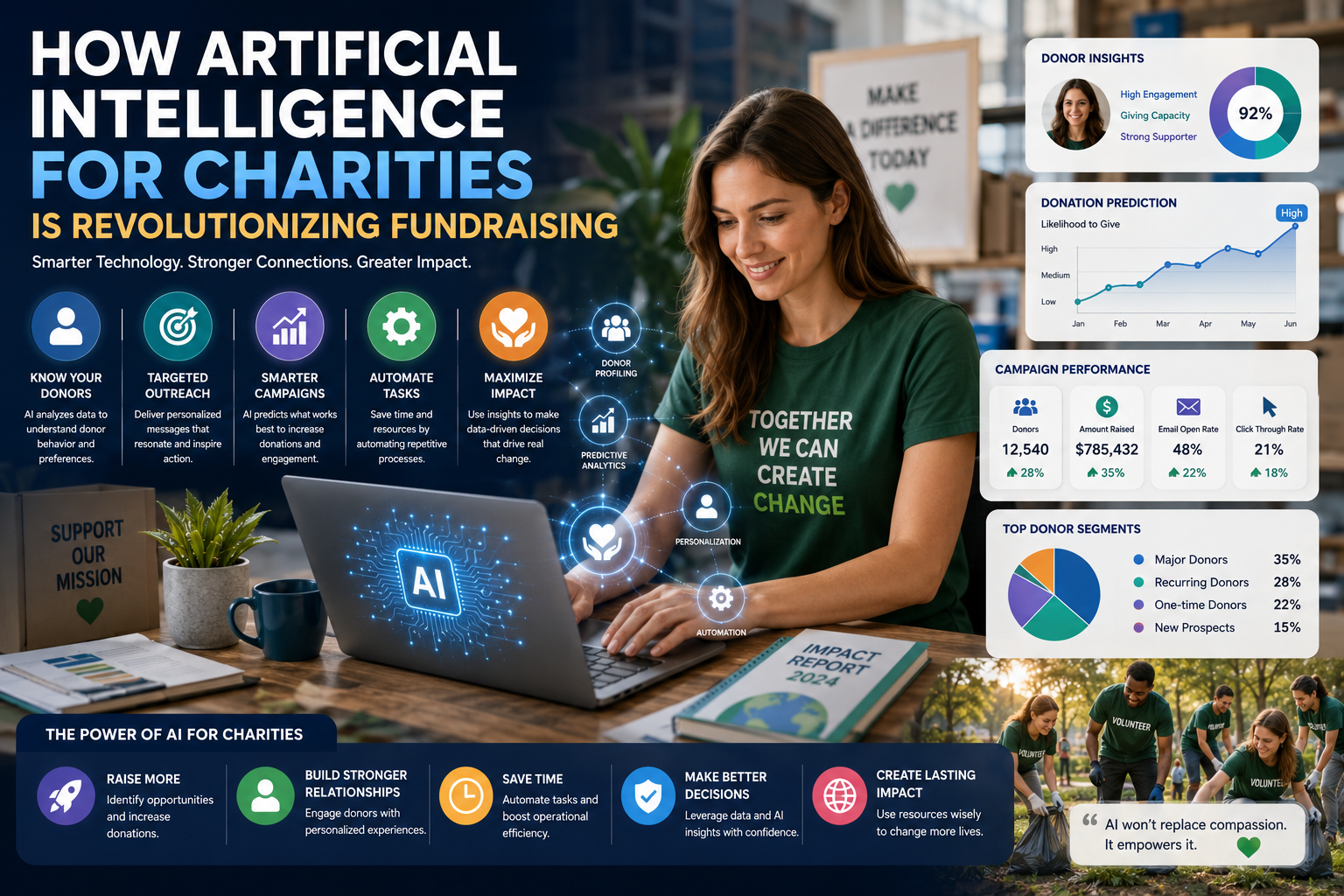
How Artificial Intelligence for Charities Is Revolutionizing Fundraising - Fundraising has always been the lifeblood of charitable organizations. Whether supporting humanitarian aid, healthcare initiatives, education programs, environmental projects, or community development efforts, nonprofits depend on donations to achieve their missions. However, fundraising has become increasingly competitive in recent years. Donors have more choices than ever, communication channels are crowded, and organizations must demonstrate measurable impact to maintain support.
In response to these challenges, many nonprofits are embracing artificial intelligence for charities as a powerful tool for improving fundraising performance. Once considered a technology primarily used by large corporations, artificial intelligence is now helping charities of all sizes engage donors, optimize campaigns, improve efficiency, and increase donations.
The adoption of AI is transforming how charitable organizations identify supporters, communicate with donors, manage fundraising campaigns, and measure success. As technology continues to evolve, organizations that effectively leverage AI are gaining a significant advantage in an increasingly competitive philanthropic landscape.
The Growing Importance of AI in Fundraising
Fundraising has traditionally relied on human expertise, personal relationships, and historical donor data. While these elements remain essential, modern fundraising generates enormous amounts of information that can be difficult to analyze manually.
Donation records, event registrations, email engagement, website activity, volunteer participation, and social media interactions all produce valuable data. Extracting meaningful insights from this information can overwhelm nonprofit teams with limited staff and resources.
This is where artificial intelligence for charities provides substantial value. AI systems can process vast amounts of data quickly, identify patterns, and generate actionable insights that help organizations make smarter fundraising decisions.
Rather than replacing fundraisers, AI enhances their capabilities by automating routine tasks and providing strategic recommendations.
Understanding Artificial Intelligence for Charities
At its core, artificial intelligence for charities refers to the use of machine learning, predictive analytics, natural language processing, and automation technologies to improve nonprofit operations and fundraising activities.
These technologies help organizations:
- Analyze donor behavior
- Personalize communications
- Predict giving patterns
- Automate administrative tasks
- Improve campaign performance
- Measure impact more effectively
By combining human expertise with advanced analytics, charities can create stronger donor relationships and maximize fundraising outcomes.
Personalized Donor Engagement
One of the most significant advantages of AI is its ability to personalize donor experiences.
Modern donors expect relevant and meaningful communication. Generic fundraising messages often fail to capture attention because they do not address individual interests or motivations.
Using artificial intelligence for charities, organizations can analyze donor data to better understand:
- Giving history
- Preferred causes
- Donation frequency
- Event attendance
- Communication preferences
- Engagement patterns
With these insights, nonprofits can deliver tailored messages that resonate with each donor.
For example, a supporter who frequently contributes to environmental programs may receive updates about conservation projects, while another donor interested in education initiatives may receive information about scholarship programs.
This level of personalization helps strengthen donor relationships and encourages long-term support.
Predictive Analytics for Smarter Fundraising
Predictive analytics is one of the most powerful applications of AI in fundraising.
Rather than simply analyzing past performance, predictive models forecast future donor behavior.
Organizations can use artificial intelligence for charities to identify:
- Potential major donors
- Likely recurring donors
- Supporters at risk of disengaging
- Prospects with high giving potential
- Optimal fundraising opportunities
These insights allow fundraising teams to prioritize their efforts more effectively.
Instead of allocating resources equally across all supporters, nonprofits can focus on donors who are most likely to respond positively to specific campaigns.
This data-driven approach often leads to higher fundraising efficiency and improved return on investment.
Improving Donor Retention
Acquiring new donors is important, but retaining existing supporters is often more cost-effective.
Many organizations struggle with donor retention because they lack visibility into changing donor behavior.
AI helps identify early warning signs that supporters may be losing interest.
Indicators may include:
- Reduced email engagement
- Lower event participation
- Longer periods between donations
- Decreased website activity
By monitoring these patterns, nonprofits can proactively reconnect with donors before they disengage completely.
Using artificial intelligence for charities, fundraising teams can create targeted retention strategies that strengthen long-term relationships and increase donor lifetime value.
AI-Powered Prospect Research
Finding new donors traditionally requires extensive research and manual effort.
Fundraisers often spend hours reviewing public records, analyzing wealth indicators, and identifying individuals who may have an interest in supporting a particular cause.
AI significantly streamlines this process.
Advanced prospect research platforms can:
- Analyze donor databases
- Identify giving trends
- Evaluate philanthropic interests
- Assess donation capacity
- Rank fundraising prospects
As a result, organizations can spend less time searching for potential supporters and more time building meaningful relationships.
This improved efficiency allows fundraising teams to focus on strategic activities that drive greater impact.
Enhancing Campaign Performance
Successful fundraising campaigns require careful planning and execution.
AI helps nonprofits optimize campaigns by providing insights into donor behavior and engagement patterns.
Organizations using artificial intelligence for charities can determine:
- The best time to send fundraising emails
- Which messages generate the highest response rates
- What donation amounts donors are likely to give
- Which communication channels perform best
- How to segment donor audiences effectively
These insights help nonprofits design campaigns that are more targeted and effective.
By making data-driven decisions, organizations can improve fundraising outcomes while reducing wasted effort.
Automating Routine Tasks
Administrative responsibilities often consume valuable staff time.
Tasks such as data entry, donor record management, scheduling, and reporting can limit an organization's ability to focus on mission-driven work.
AI-powered automation reduces these burdens by handling repetitive processes.
Examples include:
- Updating donor records
- Sending personalized emails
- Scheduling follow-ups
- Processing donations
- Generating reports
- Managing supporter inquiries
Automation improves efficiency while allowing staff to devote more attention to relationship-building and program development.
This operational improvement is one of the key reasons why nonprofits are increasingly investing in AI technologies.
AI and Grant Writing
Grant funding remains a critical source of revenue for many nonprofits.
However, preparing grant applications can be time-consuming and resource-intensive.
AI-powered writing tools help organizations streamline this process by assisting with:
- Proposal drafting
- Research summaries
- Program descriptions
- Budget narratives
- Editing and proofreading
While human oversight remains essential, AI can significantly reduce the time required to prepare high-quality grant submissions.
Many organizations now view AI-assisted grant writing as an important component of modern fundraising strategy.
Chatbots and Virtual Donor Support
Supporters increasingly expect immediate responses when interacting with organizations.
AI-powered chatbots provide 24-hour assistance by answering common questions and guiding users through the donation process.
These virtual assistants can help with:
- Donation inquiries
- Event registration
- Volunteer opportunities
- Program information
- Membership questions
Chatbots improve supporter experiences while reducing the workload placed on nonprofit staff.
As conversational AI technology continues to advance, virtual assistants are becoming more capable of handling complex donor interactions.
Data-Driven Decision Making
Effective fundraising requires informed decision-making.
Nonprofit leaders must determine where to allocate resources, which campaigns to prioritize, and how to maximize donor engagement.
AI provides valuable insights that support strategic planning.
Using artificial intelligence for charities, organizations can analyze fundraising performance across multiple channels and identify opportunities for improvement.
These insights help leaders:
- Set realistic fundraising goals
- Allocate budgets effectively
- Evaluate campaign success
- Improve operational efficiency
- Strengthen donor engagement strategies
The result is a more informed and proactive approach to fundraising management.
Measuring Fundraising Impact
Donors increasingly want evidence that their contributions are making a difference.
AI helps nonprofits collect and analyze data related to program outcomes and fundraising effectiveness.
Organizations can use AI to:
- Track donor retention rates
- Monitor campaign performance
- Measure program outcomes
- Generate impact reports
- Evaluate fundraising strategies
By demonstrating measurable results, charities can build greater trust and transparency with supporters.
This increased accountability often strengthens donor confidence and encourages continued giving.
Challenges of AI Adoption
Despite its many advantages, AI adoption is not without challenges.
Data Privacy
Nonprofits often manage sensitive donor information.
Organizations must ensure that AI systems comply with privacy regulations and maintain strong data protection practices.
Technology Costs
Although AI tools are becoming more affordable, implementation may still require investment in software, training, and infrastructure.
Staff Training
Successful adoption depends on staff understanding how to use AI tools effectively.
Organizations must provide adequate training and support.
Ethical Considerations
AI systems can reflect biases present in training data.
Nonprofits must monitor outcomes carefully to ensure fairness and avoid unintended discrimination.
Addressing these challenges is essential for responsible AI implementation.
The Future of AI in Fundraising
The role of AI in charitable fundraising is expected to expand significantly in the coming years.
Future developments may include:
- Hyper-personalized donor experiences
- More accurate giving predictions
- Advanced donor journey mapping
- Automated grant opportunity discovery
- AI-powered fundraising assistants
- Enhanced impact analytics
As these technologies become more sophisticated, nonprofits will gain access to tools that were previously available only to large organizations with extensive resources.
This democratization of technology has the potential to transform fundraising across the entire nonprofit sector.
Why Human Relationships Still Matter
Despite the growing influence of technology, fundraising remains fundamentally about people.
Donors give because they believe in a mission, trust an organization, and want to create positive change.
While artificial intelligence for charities can improve efficiency and provide valuable insights, it cannot replace empathy, compassion, and authentic human connection.
The most successful organizations use AI as a complement to human expertise rather than a substitute for it.
Technology can help identify opportunities and streamline processes, but meaningful relationships remain at the heart of charitable giving.
Conclusion
The rise of artificial intelligence for charities is revolutionizing fundraising by helping nonprofits engage donors more effectively, improve campaign performance, automate routine tasks, and make data-driven decisions. From predictive analytics and personalized communication to grant writing and impact measurement, AI offers powerful tools that enhance every stage of the fundraising process.
As competition for donor attention continues to increase, organizations that embrace AI responsibly will be better positioned to achieve their fundraising goals and expand their social impact. While challenges related to privacy, ethics, and implementation remain important considerations, the benefits of AI are becoming increasingly clear.
By combining innovative technology with strong human relationships, charities can build more effective fundraising strategies and create lasting positive change in the communities they serve.